The short answer
Bank executives look and sound best on camera when a producer interviews them instead of handing them a script. Keep each video to one idea, wear solid mid-tone clothing, film somewhere quiet with depth behind them, and use two or three cameras so the edit stays tight. Short clips from the same interview then carry the message to LinkedIn.
Bank executives look and sound best on camera when they are interviewed, not asked to perform. A producer asks good questions off camera, the leader answers in their own words, and the edit shapes those answers into a short, clear message that still sounds like them. Big Wave Productions runs nearly every shoot with bank leaders this way.
Most of what makes a CEO look confident on video is decided before the camera rolls: the format, the wardrobe, the room and the questions.
Interview or teleprompter: which works better?
An interview works better for most executive videos. A teleprompter works when the words cannot change.
Reading on camera is a skill that news anchors practice for years. Most bank leaders are excellent in a room with customers or a board, and then a prompter turns them into someone reading a statement. Their eyes track side to side, their pace flattens, and they stop sounding like themselves.
The audience notices. In the 2025 Sprout Social Index, consumers ranked authenticity and relatability as the most important traits of brand content. "Polished" and "off-the-cuff" both landed near the bottom. Viewers want something between slick and unprepared. A planned interview lands there: real answers, shaped by an edit you control.
| Format | Best for | Watch out for |
|---|---|---|
| Interview (producer off camera) | Strategy messages, community stories, thought leadership, recruiting | Needs a skilled interviewer and a disciplined edit |
| Teleprompter | Regulatory statements, short approved announcements, exact wording | Flat delivery, visible eye movement, more takes |
| Hybrid | Annual meeting messages, merger and rebrand announcements | Decide which lines are locked before shoot day |
We often do both in one session. The executive reads the two or three lines legal has locked, then we push the prompter aside and talk.
How we coach executives who are not actors
Coaching starts days before the shoot. This is how we usually run it:
- A 20-minute prep call. We talk through the message, the audience and where the video will live. We send three to five talking points instead of a script.
- Questions in advance. The executive sees the questions ahead of time so nothing feels like a quiz. We ask them not to memorize answers.
- A warm-up question. The first question on camera is easy and rarely makes the edit. "How did you get into banking?" loosens everyone up.
- Full-sentence answers. We ask the executive to fold the question into the answer ("What I'm proudest of this year is...") so every clip stands on its own without the interviewer's voice.
- Permission to restart. Anyone can stop mid-sentence and start over. That one rule takes most of the pressure off.
- A little more energy. The camera flattens energy slightly. We ask for about ten percent more than feels natural, and it reads as normal on screen.
The leader looks at the interviewer, sitting just beside the lens, not into the camera. That eyeline feels like a conversation to the viewer. Direct-to-lens delivery works for short social clips and calls to action, so we shoot a few of those at the end. For the full prep list your team can share internally, see how to prepare for a corporate video shoot.
What should a bank executive wear on camera?
Wear what you would wear to your most important client meeting, then simplify it.
- Solid, mid-tone colors: navy, gray, blue, burgundy, forest green.
- No fine stripes, tight checks or herringbone. They create a shimmering pattern on camera called moiré.
- Stark white and pure black are harder to expose next to skin. A light blue shirt usually looks better than bright white.
- Skip jewelry that clinks or brushes the lapel, where the wireless mic clips on.
- Bring a second outfit, a lint roller and anything you want for touch-ups.
- Glasses are fine. We angle the lights to keep reflections out of the lenses.
- A little translucent powder controls shine under lights. Everyone gets offered it.
Match the setting and the brand. A community bank CEO in a branch lobby can look right without a jacket. A holding company chair at headquarters probably wants one.
Choosing the setting
The best setting says something about the institution and is quiet enough to record clean audio. We look for three things:
- Depth. The executive sits several feet in front of the background, so it falls slightly out of focus and the person stands out.
- Meaning. A branch lobby, a view of the downtown they serve, a community space they helped build.
- Control. We need to shut off loud HVAC, silence phones and keep foot traffic away for about an hour.
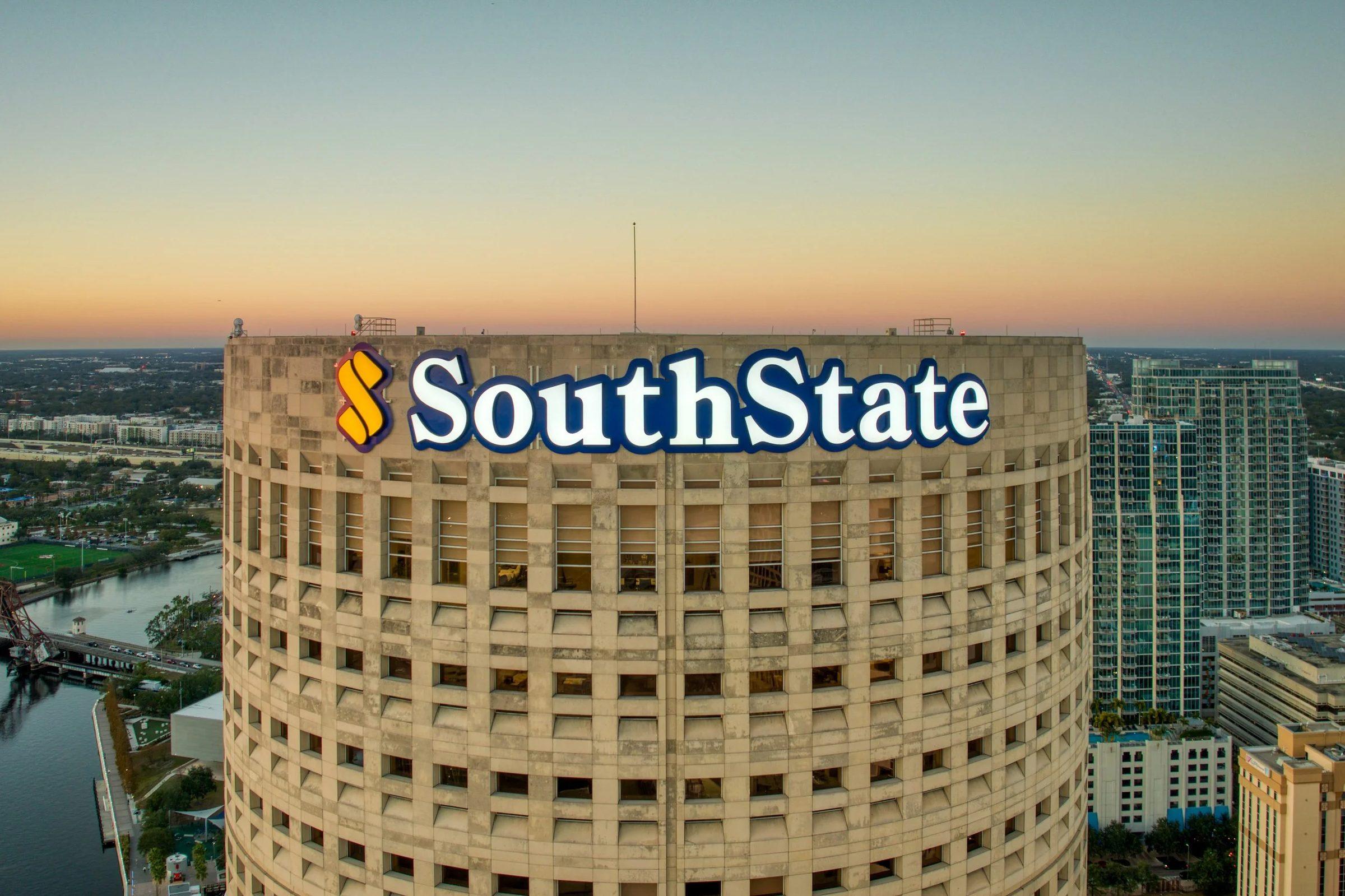
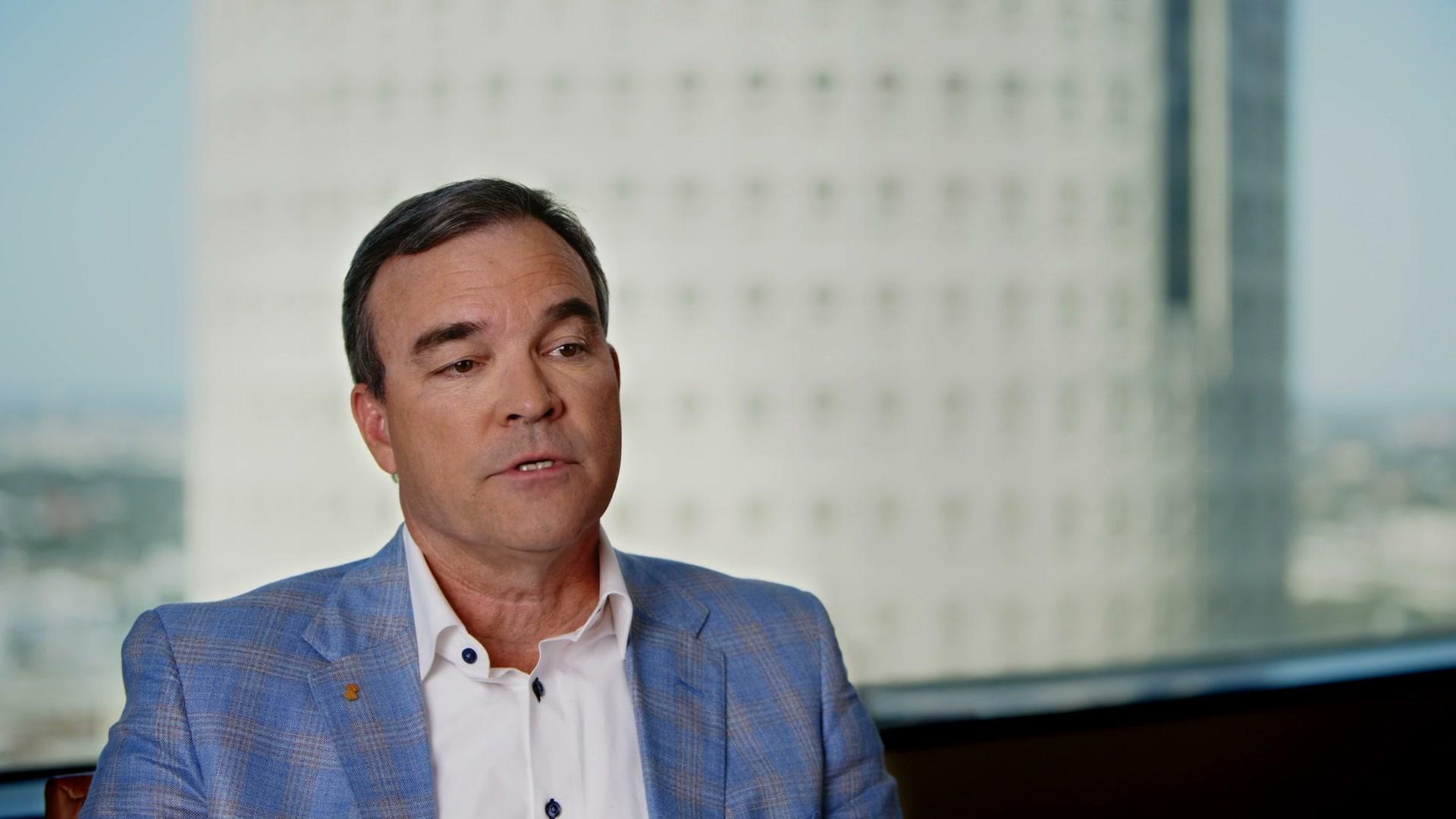
For SouthState Bank's Rivergate Tower film in Tampa, we interviewed four leaders: SouthState's CEO, Tampa's mayor, SouthState's West Florida Division President and the president of the Tampa Bay Economic Development Council. Those interviews were cut together with aerials, skyline footage and a timelapse of the signage installation, and the film premiered at the grand opening. A film like that only works if every speaker looks like part of the same story, which comes down to matching light, framing and color across each interview. The full story is in our SouthState Bank case study.
Why we film executive interviews with two or three cameras
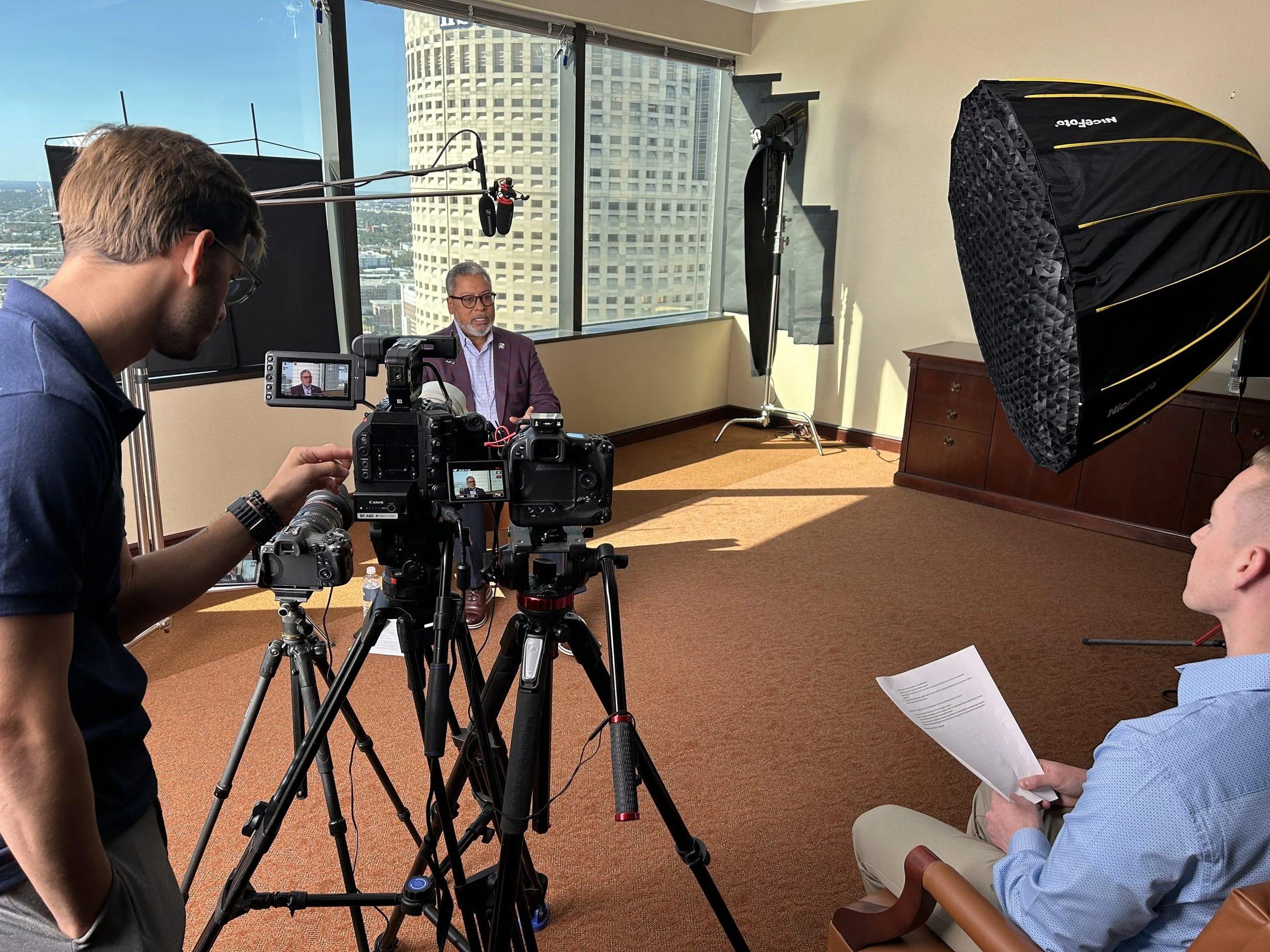
Multiple cameras make executives look better and make the edit shorter. With a medium shot and a tight shot running together, the editor can remove a stumble, a long pause or a repeated phrase without a jump in the picture. The executive does not need a perfect take. They need good answers.
On a typical executive shoot we run:
- An A camera at a medium shot, slightly off-axis, matching the interviewer's eyeline.
- A B camera at a tighter angle from the side for emphasis and cutaways.
- A third camera for a wide or profile angle when the room allows it.
We capture on RED and Canon cinema cameras, including the Canon C70, in 4K or 6K, with wireless audio on every speaker. The extra resolution lets us reframe in the edit, including vertical crops for Reels and LinkedIn, without a separate shoot.
Keep it short
One video, one idea. Executive messages that try to cover the year, the strategy, the new branch and the community commitment end up saying nothing anyone remembers.
Our starting points for length:
- Social clip: 15 to 45 seconds. One answer, one point.
- Leadership message: 60 to 120 seconds.
- Feature or brand film with executives: 2 to 3 minutes, with b-roll doing much of the talking.
Sprout Social's 2024 consumer research, as reported by ABA Banking Journal, found that short videos of up to 30 seconds topped consumers' wish lists for social content. Shorter also means less for your compliance team to review.
Cutting LinkedIn thought leadership clips from one interview
LinkedIn is where bank executives build a reputation with business owners, other bankers, civic leaders and future hires. The efficient way to feed it is one well-planned interview cut into many clips.
Before the shoot, we write six to ten questions that each produce a stand-alone answer. Good ones: what the executive is watching in the local economy, one piece of advice for small business owners, why the bank chose a new market, what they look for in a new hire. On shoot day, we frame wide enough to crop vertical. In the edit, every clip gets burned-in captions for people scrolling with the sound off, a clean title card, and the executive's name and title on screen.
Post from the executive's own profile and have the bank's page reshare it. People respond to people more than to logos.
Every clip still goes through review. If an executive mentions a rate, a product term or a forward-looking statement about company performance, flag it before posting. Our bank video compliance checklist covers what reviewers usually look for.
Annual meeting videos
An annual meeting video is a recorded message from the CEO or board chair that plays at the shareholder meeting and lives on the website afterward. It gives leadership an approved, well-produced version of the year's story, so the room does not depend on a live speech going perfectly.
A strong annual meeting video usually includes:
- A two- to four-minute leadership message, often a hybrid of prompter and interview.
- B-roll from the year: branch openings, community events, employees at work.
- Short segments from other leaders, board members or long-tenured staff.
- Key numbers as motion graphics, approved by finance.
Film it four to six weeks before the meeting. Financial results, legal review and board sign-off take time, and you want room for one more round of edits.
Get your executives ready for camera
Pick the one message your CEO most needs to deliver this quarter and build the first interview around it. The LinkedIn clips and the annual meeting piece can come from the same session. Big Wave Productions films executive messages, LinkedIn series and annual meeting videos for banks and financial institutions, at headquarters or in any branch your leaders want to be seen in. See how we approach executive video for banks, then book a free discovery call with Brian, or call or text the office at 407.498.5980.
Sources
- Sprout Social, The 2025 Sprout Social Index, survey of 4,044 consumers in the U.S., U.K., Canada and Australia, fielded September 13 to 27, 2024. Content trait rankings are in the full report PDF.
- Karen Kroll, "The value of video to social media", ABA Banking Journal, April 16, 2024, citing Sprout Social's 2024 Content Benchmarks Report.