The short answer
AI is generally safe in bank video when it helps a real production: transcripts, caption drafts, audio cleanup, translation drafts and visual effects such as rotoscoping. It becomes risky when it invents people, voices or events, like synthetic customers, fake testimonials or a cloned executive voice. Have your compliance team review every AI use.
AI is safe in bank video when it helps a real production look and sound better, and risky when it invents the evidence. Transcripts, caption drafts, audio cleanup, translation drafts and visual effects like rotoscoping are production help, while synthetic customers, AI-written testimonials and cloned executive voices put trust, and possibly compliance, on the line. Big Wave Productions, a national photo and video production company headquartered in Orlando, works with banks and financial institutions, uses AI-assisted workflows in post-production when they serve the story and keeps the people on screen real.
The line: help the craft, never invent the proof
One question sorts almost every AI decision: would a viewer come away believing a real person said, did or experienced something that didn't happen? If the answer is yes, stop and take it to compliance. If it's no, you are usually looking at a craft choice.
| Use | Where it usually lands | Why |
|---|---|---|
| Transcripts and caption drafts | Use, with human review | Speeds up post. Machine errors on financial terms must be fixed. |
| Audio cleanup | Use | Removes lobby echo or HVAC hum without changing what was said |
| Rotoscoping and visual effects | Use | Changes how real footage looks, not what happened |
| Translation drafts | Use, with fluent review and compliance | Disclosures have to be right in every language |
| AI storyboards and concept frames | Use before the shoot only | Helps approvers picture the idea. Not for the final cut. |
| AI presenter or avatar | Review carefully and disclose | A realistic person who doesn't exist |
| AI b-roll of branches, crowds or events | Usually avoid | A realistic scene that never took place |
| Synthetic customers or testimonials | Avoid | Misrepresents that a customer exists or had the experience |
| Cloned executive voice | Avoid for public messages | Trains customers to trust a voice that fraudsters can copy |
Where is AI safe to use in bank video?
In the edit
Post-production is where AI does its most useful work on a bank project. It can transcribe hours of interviews so an editor can search for the best answer, draft caption files, pull background noise out of a branch recording, and rough out a translation for a Spanish version. Each task saves time on a real recording. None changes what anyone said.
Human review is the part you can't skip. YouTube's own help center says automatic captions "might misrepresent the spoken content due to mispronunciations, accents, dialects, or background noise" (YouTube Help). In bank video, a misheard APY or rate is a compliance problem, not a typo. Our guide to captions and accessibility for bank video covers the review step.
In visual effects
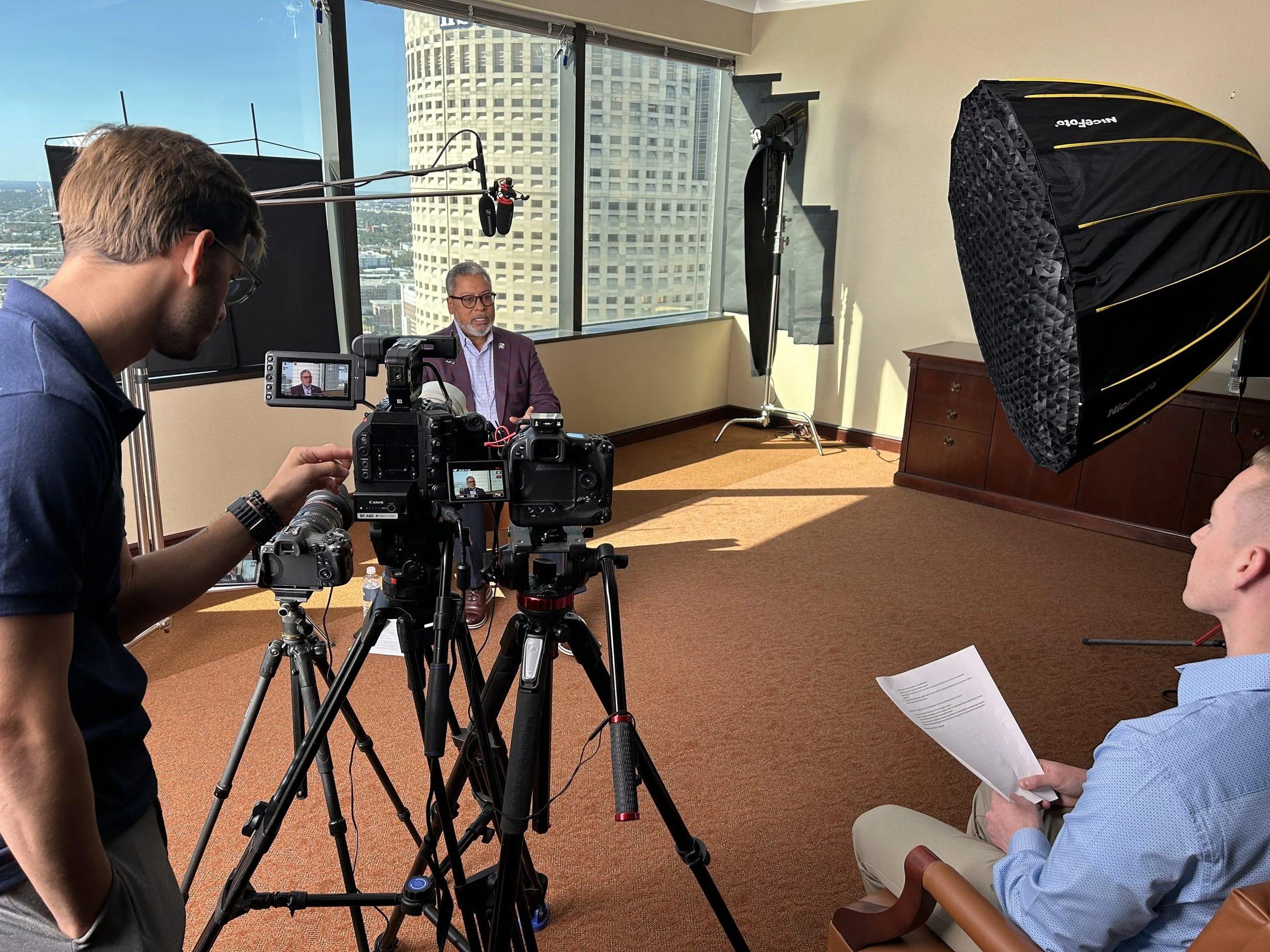
For SouthState Bank, Big Wave produced a social video pairing NFL running back Rachaad White with Angel Gonzalez, SouthState's West Florida Division President. The opening sequence and a football spiral close-up used VFX rotoscoping and AI-assisted effects, alongside custom graphics and animation. Rotoscoping isolates a subject from the background frame by frame, so graphics and effects can move behind or around them. Two of SouthState Bank's five most-viewed Instagram reels were Big Wave productions, and this video was one of them.
That project shows where the line sits. The athlete and the division president were real people. AI helped with how the frames looked, not with who was in them.
Before the shoot
AI image tools can rough out storyboards and concept frames so executives and compliance can react to an idea before anyone books a location or a crew. Keep those frames in the planning deck. They are sketches, not footage.
When does AI video hurt a bank's trust?
Synthetic customers and testimonials
A customer story works because it is a real person's real experience. An AI-generated "customer" breaks that promise, and the rules have caught up.
The FTC's Trade Regulation Rule on the Use of Consumer Reviews and Testimonials, announced in August 2024 and in effect since October 21, 2024, makes it a violation for a business to create a consumer or celebrity testimonial that materially misrepresents that the person exists or used the product, or to spread one it knew or should have known did. The FTC's announcement says the ban reaches AI-generated fake reviews.
The FTC Act carves banks out of the FTC's own Section 5 authority (15 U.S.C. 45(a)(2)). Your prudential regulator still examines your ads for deception. Treat the FTC rule as the line, and ask your compliance team how your regulator applies it. For real customers done well, see our guide to bank customer testimonial videos.
AI presenters and avatars
An AI avatar reading a product explainer isn't pretending to be a customer, but it is a realistic person who doesn't exist. The major platforms ask for disclosure here:
- Meta says it may require an AI label on Facebook, Instagram and Threads when content has "photorealistic video or realistic-sounding audio" that was digitally created or altered, and it lists a reel narrated with a realistic AI-generated voiceover as an example (Meta Help Center).
- YouTube requires creators to disclose realistic altered or synthetic content, including content that makes a real person appear to say or do something they didn't, or that "generates a realistic scene that didn't actually occur" (YouTube Help).
- TikTok requires creators to label AI-generated or significantly edited content "that shows realistic-looking scenes or people" (TikTok Community Guidelines).
Then ask what an avatar says about your institution. Community banks and financial institutions sell relationships with real people in real branches. A synthetic face gives away the one advantage a national competitor can't copy.
Cloned executive voices
This is the use we would steer every bank away from. FinCEN's alert on fraud schemes involving deepfake media (FIN-2024-Alert004, November 13, 2024) reports an increase since 2023 in suspicious activity reports describing suspected deepfake use, and notes that criminals have reportedly used generative AI to impersonate an executive or trusted employee and instruct victims to send money. The FBI's December 2024 public service announcement warns that criminals use AI-generated audio to impersonate public figures and relatives to get payments.
If your CEO's voice messages are sometimes synthetic, customers and employees lose a simple test: it sounds like her, so it is her. Real recordings, posted only on your own verified channels, make the real voice easier to trust and a fake easier to question.
Outbound calls raise a separate rule. In February 2024 the FCC ruled that AI-generated voices are "artificial" under the Telephone Consumer Protection Act, which brings voice-cloned calls under the same restrictions as other artificial or prerecorded voice calls (FCC news release). Talk to compliance before an AI voice goes anywhere near a phone campaign.
Deepfakes make your real video more valuable
The FinCEN alert lists red flags for deepfake identity fraud, such as a customer using a third-party webcam plugin during a live verification check. Spotting those is your fraud team's job. Marketing's job is making the real institution easy to recognize:
- Publish executive messages only on official channels, and list those channels on your website.
- Tell customers in plain words what you will never ask for by phone, text or video call.
- Put fraud education on the social calendar. Our guide to fraud and scam awareness videos covers formats that work.
- Keep an archive of official videos, so anything suspicious can be checked against the real record.
The FBI's announcement advises people to limit online content of their image or voice where possible. That doesn't mean your CEO should disappear from camera, since visible leadership is part of how a community institution earns trust. It means your security team should know which executives are public, and no payment approval should rest on a familiar voice or face alone. FinCEN names multifactor authentication and live verification checks among the practices that reduce exposure to deepfake identity documents.
Who owns AI-generated footage?
The U.S. Copyright Office's January 2025 report on copyrightability concluded that generative AI outputs can be protected "only where a human author has determined sufficient expressive elements," that prompts alone don't qualify, and that using AI to assist a human creator doesn't bar protection. For a bank, a spot generated entirely from prompts may be hard to protect, while footage shot by a crew, edited by people and covered by a written usage agreement stands on firmer ground. Ask counsel how this applies to your work, and see our guide to usage rights and music licensing.
An AI checklist for your compliance team
Before any video with AI in it goes live, answer these in writing:
- Does anyone or anything on screen look real but not exist, or show an event that didn't happen?
- Did every real person whose face or voice was altered agree to it in writing?
- Did a person review every transcript, caption file and translation?
- Do the Meta, YouTube or TikTok disclosure labels apply to this cut?
- Does every testimonial come from a real customer with a signed release?
- Who approved the AI use, and on what date?
Keep the answers in the project file. If an examiner or a customer asks how a video was made, the record is ready.
Keep the cast real
AI belongs in the production toolkit, not in the cast list. Big Wave Productions films real customers, employees and leaders for bank video production projects and uses AI-assisted tools in post where they make the work better. To talk through a project and where AI fits in it, book a free discovery call with Brian, or call or text 407.498.5980.
Sources
- FinCEN, FinCEN Alert on Fraud Schemes Involving Deepfake Media Targeting Financial Institutions, FIN-2024-Alert004, November 13, 2024.
- FBI Internet Crime Complaint Center, Criminals Use Generative Artificial Intelligence to Facilitate Financial Fraud, Alert I-120324-PSA, December 3, 2024.
- Federal Trade Commission, Federal Trade Commission Announces Final Rule Banning Fake Reviews and Testimonials, August 14, 2024, and 16 CFR 465.2.
- FTC Act Section 5, 15 U.S.C. 45.
- Federal Communications Commission, FCC Makes AI-Generated Voices in Robocalls Illegal, February 8, 2024.
- U.S. Copyright Office, NewsNet Issue 1060, January 29, 2025, and Copyright and Artificial Intelligence, Part 2: Copyrightability.
- Meta Help Center, How to identify AI content on Meta products (accessed October 2026).
- YouTube Help, Disclosing use of altered or synthetic content and Use automatic captioning (accessed October 2026).
- TikTok, Community Guidelines: Integrity and Authenticity (accessed October 2026).