The short answer
Before a bank video goes live, check the official advertising statement (Member FDIC), fair lending notices on mortgage and home equity ads, Regulation DD and Regulation Z trigger terms, UDAAP, endorsement disclosures, music licenses, talent and location releases, and every frame for customer data. This is not legal advice. Your compliance team decides.
A bank video compliance check covers the insurance statement, fair lending notices, rate and term disclosures, the overall impression of the ad, endorsement disclosures, and the production paperwork behind it. Big Wave Productions wrote this checklist from the production side of bank video. It is not legal advice. Rules change and apply differently by charter and regulator, so your compliance officer and counsel make the final call.
How compliance fits into a video schedule
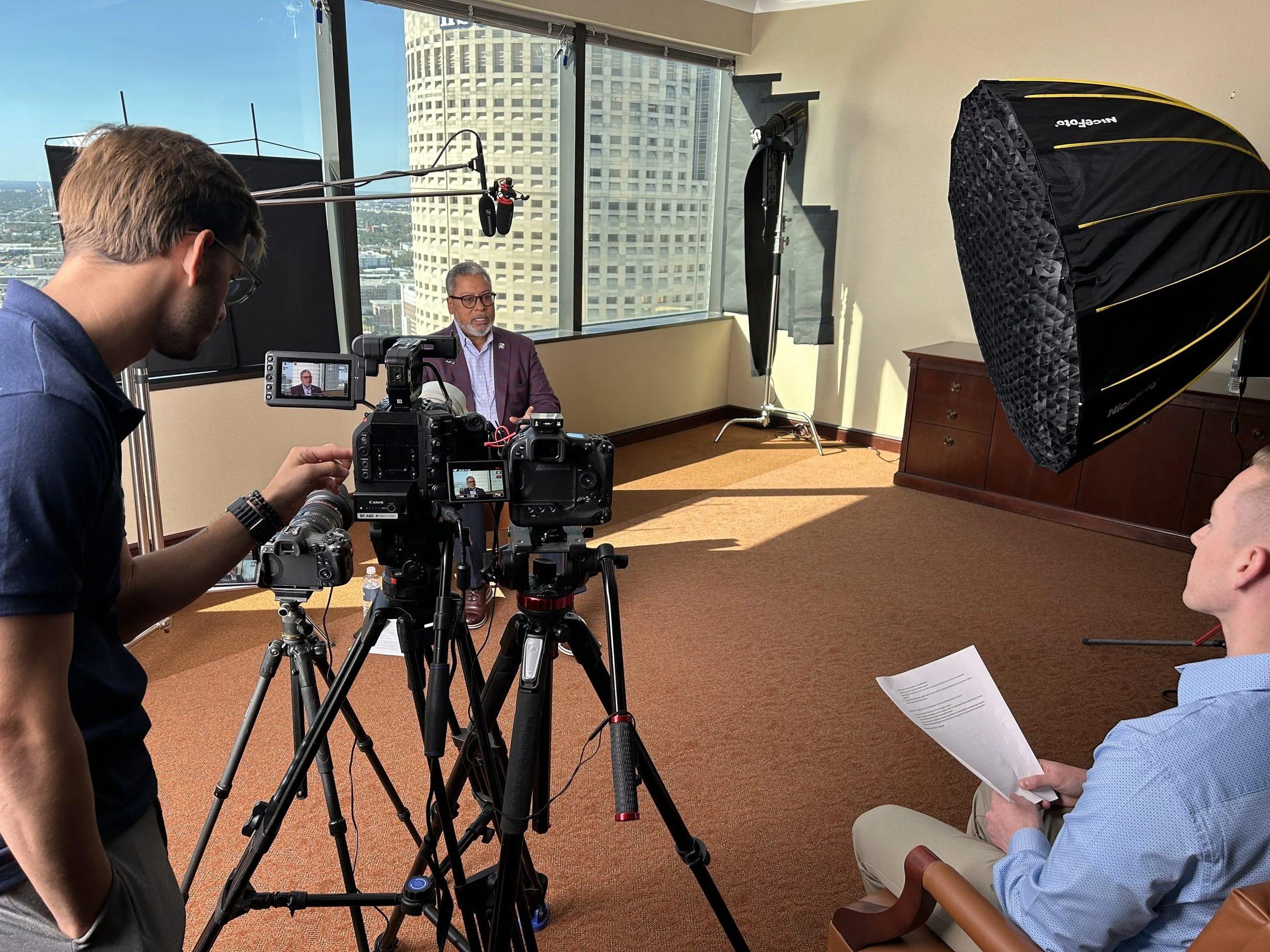
On bank projects, Big Wave Productions typically plans compliance review at three points:
- Script or interview questions. Claims and testimonial plans are reviewed before anyone is on camera.
- Rough cut. On-screen text, end cards and voiceover are reviewed in context.
- Final and every cutdown. Each version gets its own sign-off.
Share the deliverables list with compliance at kickoff. A disclosure that fits a two-minute film may not fit a six-second cut.
1. Member FDIC: the official advertising statement
Under 12 CFR 328.6, an FDIC-insured bank must include the official advertising statement in ads that promote deposit products or its banking services in general, including an ad that names the bank without listing products. The full statement is "Member of the Federal Deposit Insurance Corporation." "Member FDIC," "Member of FDIC," "FDIC-Insured" or the FDIC symbol also work, at a clearly legible size.
Three details matter for video:
- Exemptions are narrow. They include ads that do not name the bank and radio or television ads, other than display ads, of 30 seconds or less. Ask compliance how your bank applies that to social, streaming and connected TV.
- Non-deposit products are different. An ad solely about investments, insurance or annuities must not carry the statement or anything implying FDIC insurance. In mixed ads, keep the statement clearly separated. Subpart B also prohibits implying an uninsured product is FDIC-insured, including through FDIC-associated images. If a broker-dealer offers the product, FINRA Rule 2210 adds its own review.
- Legible on a phone. Test the end card at real size, and hold it long enough to read.
A note on the NCUA. Federally insured credit unions follow a separate rule, 12 CFR 740.5, which requires the NCUA official advertising statement, such as "Federally insured by NCUA," in most ads.
2. The FDIC sign rules for digital channels
The FDIC rewrote its sign and advertising rules in 12 CFR Part 328, subpart A, and the dates have moved several times:
- The final rule published January 18, 2024 took effect April 1, 2024. Compliance was later delayed to May 1, 2025.
- The ATM and digital channel sections (328.4 and 328.5) were delayed again, to March 1, 2026, and then to January 1, 2027.
- A final rule published January 29, 2026 amended both sections, effective March 2, 2026, with compliance required by April 1, 2027.
Under the amended 12 CFR 328.5, the FDIC official digital sign must appear on the homepage of the website or app, the login page, and the page where a consumer first starts opening a deposit account. Pages dedicated to non-deposit products need signage saying those products are not FDIC insured, are not deposits and may lose value.
What that means for video:
- A video embedded on your homepage or account-opening page should never cover or crowd the digital sign.
- Investment product videos belong on pages with the non-deposit signage.
- In a branch, the official sign at teller stations will be in frame, and non-deposit sales areas must already be physically separate from where deposits are taken. Frame shots that keep them apart.
3. Mortgage and home equity ads: Equal Housing Lender
Ads for loans to buy, build, improve, repair or maintain a dwelling, or loans secured by a dwelling, carry a fair lending notice. The exact rule depends on your charter:
- FDIC-supervised institutions: 12 CFR 338.3 lets a visual ad satisfy the notice with the Equal Housing Lender (or Equal Housing Opportunity) logotype and legend, and a spoken ad with the words "Equal Housing Lender" or "Equal Opportunity Lender."
- Federal savings associations: 12 CFR 128.4 requires the logotype and legend.
- Other charters: ask compliance which rule your institution follows.
Casting and imagery matter too. The FDIC rule bars words, symbols or models that suggest a discriminatory preference. Regulation B, at 12 CFR 1002.4(b), prohibits advertising statements that would discourage applicants on a prohibited basis, and it counts visual images such as photographs and videos as statements.
4. Rates and terms: Regulation DD and Regulation Z
Deposits. Under Regulation DD, 12 CFR 1030.8:
- A stated rate of return must be called the "annual percentage yield." APY is fine once the full term appears.
- Stating the APY triggers, as applicable: whether the rate is variable, how long it is offered, minimum balance, minimum opening deposit, that fees could reduce earnings, and for time accounts the term and early withdrawal penalty.
- Bonuses carry their own disclosures, and "free" cannot describe an account that may charge maintenance or activity fees.
- Broadcast and electronic media get relief from some disclosures. Ask compliance how that applies to each placement.
Loans. Under Regulation Z, 12 CFR 1026.24 covers closed-end credit like mortgages and auto loans, and 12 CFR 1026.16 covers open-end credit, including home equity lines:
- A stated rate must be called the "annual percentage rate."
- For closed-end credit, the trigger terms are the down payment, the number of payments or repayment period, the payment amount, and the finance charge. Any one of them requires the down payment, repayment terms and APR.
- Home equity plans have their own triggers in 1026.16(d).
"Ask about our CD specials" states no rate. "X.XX% APY on a 12-month CD" triggers several disclosures. Keep rates on a separate end card that can be swapped when rates move.
5. UDAAP: the overall impression
An ad can carry every required disclosure and still mislead. The Dodd-Frank Act prohibits unfair, deceptive or abusive acts or practices (12 U.S.C. 5531), and Section 5 of the FTC Act (15 U.S.C. 45) prohibits unfair or deceptive practices. In video, watch for disclosures that flash by too fast or too small, voiceover that contradicts the fine print, conditional "no fee" claims, and testimonials that imply results most customers will not get.
6. Testimonials, employees, influencers and athletes
The FTC's Endorsement Guides, 16 CFR Part 255, revised in 2023, set the standard:
- Endorsements must reflect the endorser's honest opinions and actual experience.
- Material connections, such as payment, free products, employment or family ties, must be disclosed clearly and conspicuously when the audience would not expect them.
- Advertisers can be liable for what endorsers say, and should guide and monitor them.
Banks sit outside the FTC's own Section 5 enforcement, but their own regulators examine advertising for unfair or deceptive practices, and a paid athlete or influencer is covered by the FTC directly. The FTC's guidance for influencers says a video disclosure belongs in the video itself, not only in the description.
For customer testimonials, use the customer's real words and get a signed release. For athlete collaborations, like the one Big Wave produced pairing NFL running back Rachaad White with SouthState Bank's West Florida Division President, agree on disclosure language and the athlete's own post copy before filming.
7. Music licensing
A recorded song carries two copyrights, one in the musical work and one in the sound recording, as the U.S. Copyright Office explains in Circular 56A. Using one means licensing both, or using production music licensed for your exact usage: unpaid social posts, paid ads, broadcast or a lobby display. Platform music libraries can limit business use, so check the terms first.
8. Talent, location and minor releases
Anyone identifiable who is featured should sign a talent release, and a parent or guardian signs for minors. State law governs commercial use of a person's likeness. Florida's Section 540.08, for example, requires consent. Get location releases for property the bank does not own.
9. Filming in branches without capturing customer data
Customer information is protected under the Interagency Guidelines Establishing Information Security Standards. Before filming:
- Turn off monitors or switch them to demo data.
- Clear desks, printers and whiteboards.
- Keep vaults, security systems and access codes out of frame.
- Stage transactions with employees or released talent.
- Check reflections, then review every frame in the edit.
The checklist
| Check | Applies when | Rule to cite |
|---|---|---|
| Official advertising statement (bank) | Deposit or general bank ads | 12 CFR 328.6 |
| No insurance implication | Investment, insurance or annuity content | 12 CFR 328.6(e), 328.102 |
| Digital sign stays visible | Homepage, login or account-opening pages | 12 CFR 328.5 |
| Equal Housing Lender notice and casting review | Dwelling-related loan ads, any credit ad | 12 CFR 338.3, 128.4, 1002.4(b) |
| APY and deposit disclosures | A rate or bonus is mentioned | 12 CFR 1030.8 |
| APR and trigger terms | A loan rate or term is mentioned | 12 CFR 1026.24 or 1026.16 |
| Net impression and legibility | Every video | UDAAP, FTC Act Section 5 |
| Endorsement disclosures | Testimonials, influencers, athletes | 16 CFR Part 255 |
| Music licenses on file | Any music | Copyright law |
| Releases signed | Anyone identifiable, non-bank property | State law |
| Screens and desks clean | Filming in branches or offices | Information security guidelines |
Build review into the plan
Most compliance problems we see in bank video are scheduling problems: a cutdown nobody planned for, or a rate baked into the edit. That is why Big Wave Productions puts review points on the bank video production schedule from kickoff, recommends keeping disclosures on separate end cards so they can be updated, and sends cutdowns back for sign-off. Your compliance team still makes every call. When you are ready to plan a shoot, book a discovery call.
Sources
- FDIC: 12 CFR Part 328, subpart A, subpart B, and Federal Register notices 89 FR 3504, 89 FR 84261, 90 FR 11659, 90 FR 54544 and 91 FR 3801.
- NCUA: 12 CFR 740.5.
- Fair lending: 12 CFR 338.3, 12 CFR 128.4, 12 CFR 1002.4.
- Rates and terms: 12 CFR 1030.8, 12 CFR 1026.24, 12 CFR 1026.16.
- UDAAP: 12 U.S.C. 5531, 15 U.S.C. 45.
- Endorsements: 16 CFR Part 255, FTC Disclosures 101, FINRA Rule 2210.
- Production: Copyright Office Circular 56A, Florida Statutes 540.08, 12 CFR Part 364, Appendix B.